For Informational Purposes Only
Lateral vs. Sitting Position for Neuraxial Anesthesia
Disclaimer: This article is intended solely for informational and educational purposes only. It does not constitute medical advice.
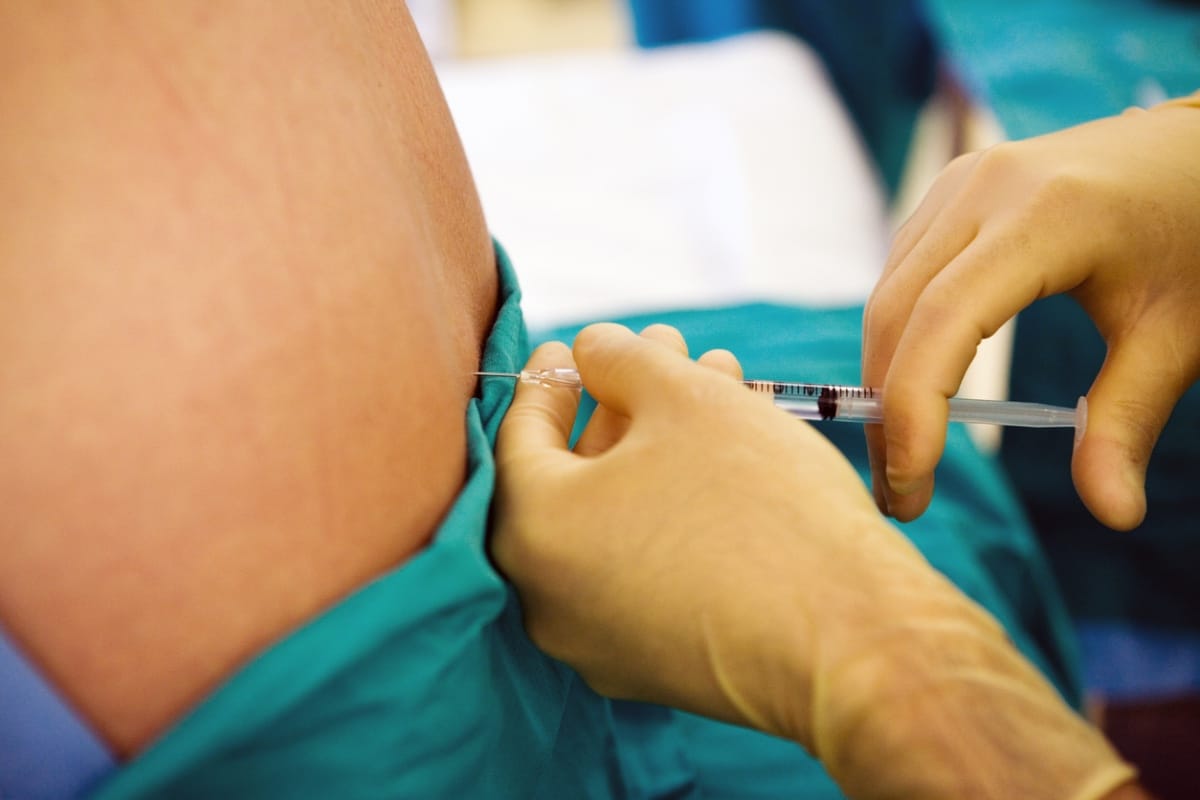
Neuraxial anesthesia techniques including spinal, epidural, and combined approaches remain fundamental to contemporary anesthesia practice. Success depends on pharmacologic factors and patient positioning. The lateral decubitus and sitting positions are most frequently employed, each with distinct benefits and drawbacks determined by clinical circumstances, patient characteristics, and provider expertise.
The sitting position is commonly selected for spinal procedures, particularly in obese patients or those with unclear anatomical landmarks. This approach utilizes gravitational forces to help align lumbar vertebral spaces, facilitating needle entry. “The interspinous spaces tend to open more widely in flexed sitting patients, improving access to the epidural or subarachnoid space” (Soltani Mohammadi et al, 2017). Sitting also enables better midline maintenance during guidance. However, hypotensive or elderly patients may struggle with this position due to venous pooling and heightened vasovagal episode risk (Madan et al., 2026).
The lateral decubitus position conversely offers enhanced comfort and hemodynamic stability, benefiting patients unable to tolerate sitting from pain, weakness, or cardiovascular concerns. It permits comfortable maintenance of lumbar and hip flexion throughout the procedure, supporting neuraxial needle placement (Poots et al., 2024). Additionally, this position reduces sudden movement risks during needle insertion and is preferred for pediatric patients, labor analgesia, and selected geriatric populations. Identifying midline landmarks proves more difficult in obese patients, and “recent imaging studies suggest that increasing lumbar flexion in the lateral decubitus position does not substantially increase the width of the interlaminar spaces” despite traditional teaching (Poots et al., 2024).
Another factor involves desired neuraxial anesthesia block distribution. “The lateral position may increase the chance of unilateral or asymmetric blocks if the patient remains in one position after injection, while the sitting position tends to yield more symmetric spread due to gravitational influence” (Wen et al., 2024). This pharmacodynamic variation emphasizes repositioning importance following neuraxial injection, particularly with hyperbaric solutions.
Both positions provide distinctive neuraxial anesthesia advantages. Selection should be individualized based on patient anatomy, hemodynamic condition, and surgical context. Comprehending each position’s nuances enhances block success, reduces complications, and optimizes patient outcomes.
References
- Madan, M., Kaur, R., Sodhi, S. S., & Maingi, S. (2026). Recurrent vasovagal syncope triggered by procedural pain and post-operative analgesia during spinal anesthesia for high tibial osteotomy: A case report. Journal of Orthopaedic Case Reports, 16(6), 468–471. https://doi.org/10.13107/jocr.2026.v16.i06.7510
- Poots, C., & Chin, K. J. (2024). Strategies for successful lumbar neuraxial anaesthesia and analgesia in patients with challenging anatomy. BJA Education, 24, 46–56. https://doi.org/10.1016/j.bjae.2023.10.006
- Soltani Mohammadi, S., Piri, M., & Khajehnasiri, A. (2017). Comparing three different modified sitting positions for ease of spinal needle insertion in patients undergoing spinal anesthesia. Anesthesia and Pain Medicine, 7(5), e55932. https://doi.org/10.5812/aapm.55932
- Wen, C., Xiang, Y. Y., Pang, Q. Y., & Liu, H. L. (2024). Effects of neuraxial anesthesia in sitting and lateral positions on maternal hemodynamics in cesarean section: A systematic review and meta-analysis. PLOS ONE, 19(5), e0303256. https://doi.org/10.1371/journal.pone.0303256