Disclaimer: This article is intended solely for informational and educational purposes only. It does not constitute medical advice.
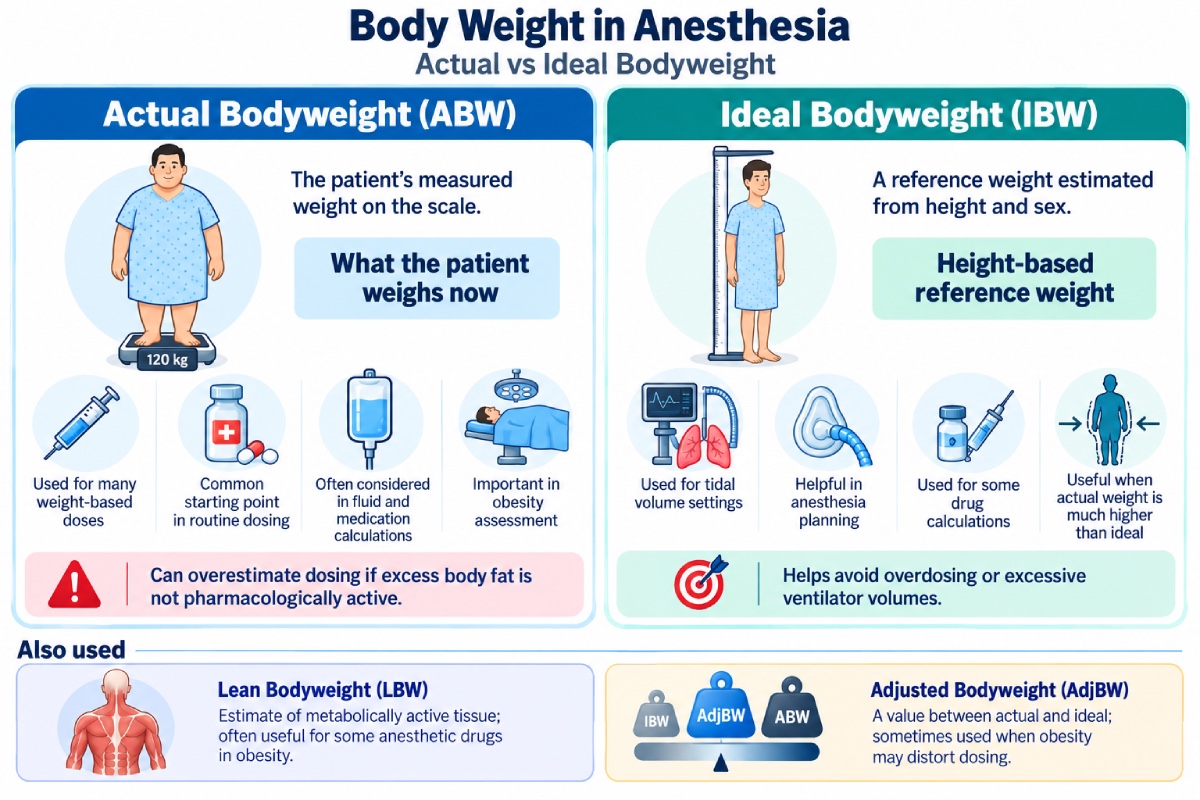
Body weight is a fundamental variable in anesthetic practice, influencing drug dosing, ventilator settings, fluid therapy, and perioperative risk assessment. However, actual body weight (ABW) does not always represent the physiologic compartment that determines the pharmacokinetics or pharmacodynamics of a medication. This distinction becomes particularly important in patients with obesity, where excessive adipose tissue alters drug distribution, clearance, respiratory mechanics, and cardiovascular physiology. Consequently, anesthesia providers and other clinicians may use ideal body weight (IBW), lean body weight (LBW), adjusted body weight (AdjBW), or a combination of these measures rather than relying exclusively on actual body weight.
IBW is derived from height and sex. Its application in anesthesia is particularly useful for determining ventilator settings. In obese patients, tidal volume for lung-protective ventilation should generally be based on predicted or ideal body weight rather than ABW because lung size correlates more closely with height than with total body mass. Using ABW to calculate tidal volume may result in unnecessarily large tidal volumes and increase the risk of ventilator-induced lung injury. IBW can be useful when considering dosing strategies for certain medications.
The choice of weight scalar for intravenous anesthetic drugs depends on the pharmacokinetic characteristics of the individual medication. Lipophilic drugs tend to distribute more extensively into adipose tissue, whereas hydrophilic drugs have a smaller volume of distribution. For induction of anesthesia with propofol, dosing according to actual body weight in patients with obesity may result in excessive administration and exaggerated cardiovascular depression. Conversely, dosing according to ideal body weight is likely to be insufficient, requiring correction and potentially exposing patients to unintended awareness or discomfort. LBW or other validated obesity-specific dosing strategies may provide a more appropriate initial estimate, with subsequent titration according to clinical response. Opioids require similar caution. Although increased body mass can increase drug distribution, accumulation and delayed respiratory depression remain important concerns, making titration to effect particularly important.
Neuromuscular blocking agents illustrate why drug-specific dosing is necessary. For highly lipophilic agents, ABW may result in excessive dosing, whereas for relatively hydrophilic drugs, IBW or LBW may be more appropriate depending on the specific agent and clinical context. Succinylcholine is an important exception because increased pseudocholinesterase activity and altered distribution in obesity may require dosing based on ABW to achieve reliable and rapid neuromuscular blockade. Reversal agents also require careful consideration of the appropriate weight scalar, and dosing should follow drug-specific recommendations rather than a generalized rule.
The selection of a metric for body weight also has implications beyond drug administration. Perioperative fluid management should not automatically be calculated from ABW in patients with obesity because adipose tissue has different metabolic and vascular characteristics from lean tissue. Similarly, renal function estimates used for medication dosing may be affected by the choice of body weight incorporated into creatinine-based equations.
The practical principle is that there is no single “correct” body weight metric for anesthesia—actual, ideal, lean, and adjusted body weight are tools that serve different purposes. IBW or predicted body weight is particularly important for lung-protective ventilation, whereas LBW or drug-specific dosing scalars may be more appropriate for many anesthetic medications. ABW remains appropriate for specific drugs, including succinylcholine, and may be relevant when calculating certain nutritional or physiologic requirements. Ultimately, the safest approach is medication- and procedure-specific: select the weight scalar supported by pharmacologic evidence, administer an appropriate initial dose, and titrate according to clinical effect, hemodynamic response, and objective monitoring when available. In obese patients in particular, recognizing that body weight is not a single physiologic variable is essential to achieving precise and safe anesthesia.
References
- Ingrande J, Lemmens HJM. Dose adjustment of anaesthetics in the morbidly obese. Br J Anaesth. 2010;105(suppl 1):i16-i23. DOI: https://doi.org/10.1093/bja/aeq312
- Erstad BL. Dosing of medications in morbidly obese patients in the intensive care unit setting. Intensive Care Med. 2004;30(1):18-32. DOI: https://doi.org/10.1007/s00134-003-2059-6
- Ingrande J, Brodsky JB, Lemmens HJM. Lean body weight scalar for the anesthetic induction dose of propofol in morbidly obese subjects. Anesth Analg. 2012;115(4):823-828. DOI: https://doi.org/10.1213/ane.0b013e3181f6d9c0
- Pai MP, Paloucek FP. The origin of the “ideal” body weight equations. Ann Pharmacother. 2000;34(9):1066-1069. DOI: https://doi.org/10.1345/aph.19381